Introduction
Facial aging is not caused by one single factor. Over time, the skin, fat compartments, bone structure, and supporting tissues of the face all undergo gradual changes. These changes may lead to wrinkles, volume loss, skin laxity, and reduced facial definition.
Today, non-surgical aesthetic treatments have become increasingly popular because they can improve facial appearance with minimal downtime compared with surgical procedures. Among these treatments, hyaluronic acid fillers are widely used for facial rejuvenation, volume restoration, contouring, and wrinkle correction.
However, the final result of filler treatment does not depend only on the type or concentration of the product. The depth of injection, anatomical area, injection technique, and tissue characteristics all play an important role in safety, longevity, and patient satisfaction.
What Is Hyaluronic Acid Filler?
Hyaluronic acid, commonly known as HA, is a naturally occurring substance found in the skin and connective tissues. It has a strong ability to attract and retain water, which helps maintain hydration, elasticity, and volume.
In aesthetic medicine, HA fillers are injectable gels used to restore lost volume, smooth wrinkles, improve facial contours, and enhance specific areas such as the lips, cheeks, chin, and nose.
Different HA fillers may vary in concentration, firmness, elasticity, cohesiveness, and lifting capacity. These physical characteristics influence where and how the filler should be injected.
Why Injection Depth Matters
One of the most important clinical decisions in filler treatment is selecting the correct injection plane.
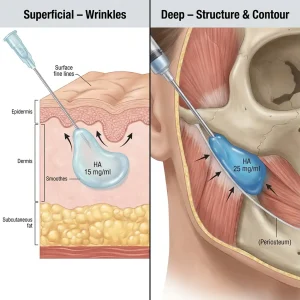
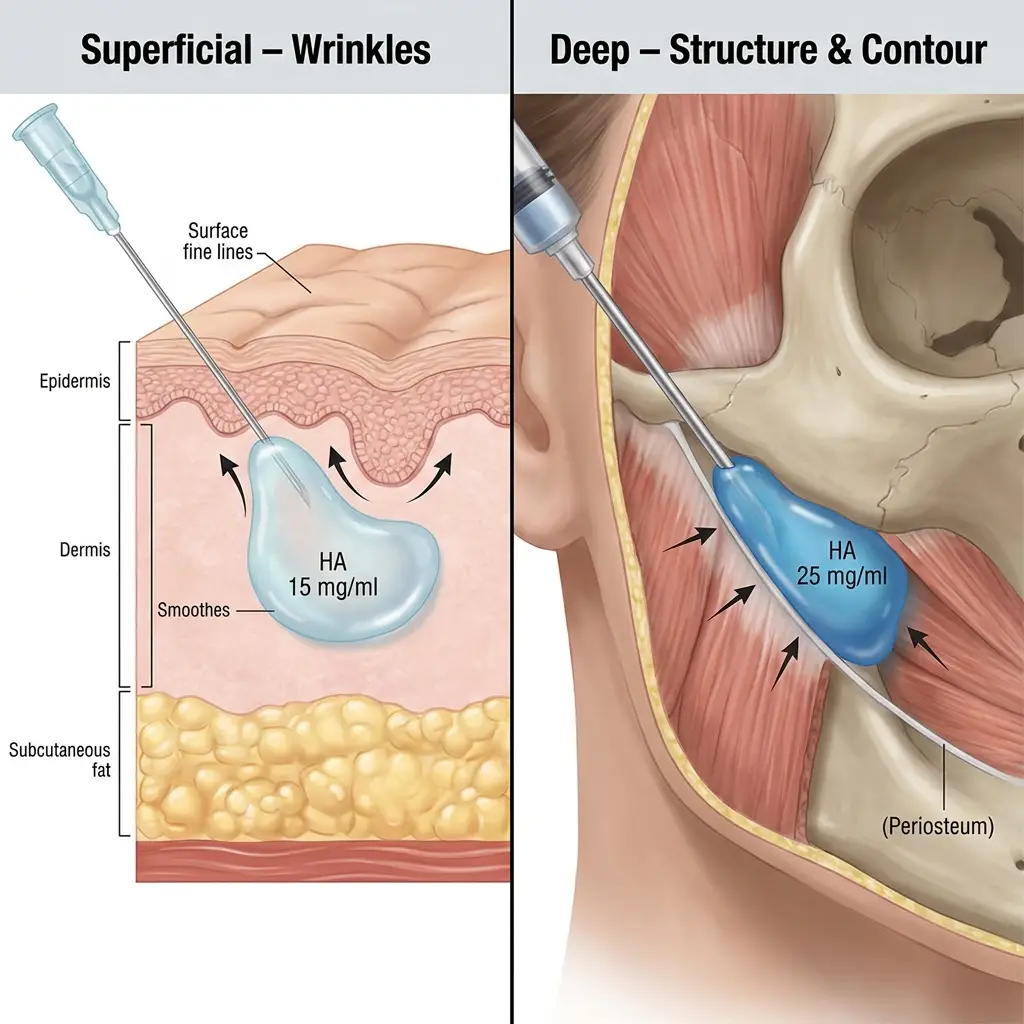
Superficial injections are usually used for fine lines and wrinkles, such as perioral lines, glabellar lines, and crow’s feet. These areas require softer fillers that integrate well into the skin and avoid visible irregularities.
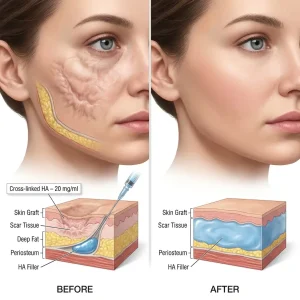
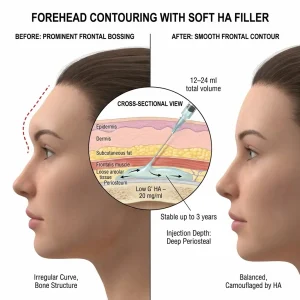
Deeper injections are generally used for structural support and contouring. Areas such as the cheekbones, chin, and nose often require firmer fillers with higher lifting capacity. These fillers are usually placed near the bone or periosteum to provide projection, definition, and longer-lasting support.
Using the wrong filler at the wrong depth may reduce effectiveness and increase the risk of complications. For example, a firm filler placed too superficially may create lumps or visible irregularities, while a soft filler placed too deeply may not provide enough lifting effect.
Overview of the Clinical Study
A clinical study published in the Journal of Clinical and Cosmetic Dermatology evaluated the use of three different reticulated hyaluronic acid fillers with different HA concentrations: 15 mg/ml, 20 mg/ml, and 25 mg/ml.
The study included 25 patients, consisting of 22 women and 3 men, aged between 27 and 58 years. All patients received aesthetic facial treatments and were followed for at least six months.
The fillers were selected according to the treatment area and injection depth:
The 15 mg/ml HA filler was used for superficial or intradermal injections, mainly for crow’s feet and glabellar wrinkles.
The 20 mg/ml HA filler was used for deeper dermal injections, mainly for nasolabial folds and perioral wrinkles.
The 25 mg/ml HA filler was used for deep bolus injections near or under the periosteum, mainly for non-surgical nose reshaping, cheek augmentation, and chin enhancement.
Treatment Areas and Techniques
For fine lines and superficial wrinkles, the filler was injected into the skin using superficial techniques. These areas require precision and a product that spreads naturally within the dermal tissue.
For nasolabial folds and perioral lines, injections were performed in the deep dermal plane. This approach aimed to soften deeper creases while maintaining a natural appearance.
For structural enhancement of the nose, chin, and malar area, the filler was injected deeply, close to the bone. This technique was used to create support, projection, and contour improvement.
The study emphasized that higher-concentration fillers with stronger lifting capacity are more suitable for deeper planes, while lower-concentration fillers are more appropriate for superficial wrinkles.
Results of the Study
All 25 patients were treated in a single injection session. The reported complications were limited. Seven patients developed bruising at the injection site, including four cases in the perioral area and three in the malar area. These bruises resolved naturally within 10 days.
No major complications such as nodules, foreign body reaction, or persistent irregularities were reported in the study.
Patient satisfaction was measured at one month, three months, and six months after treatment. The average satisfaction scores were:
1 month after treatment: 7.84 out of 10
3 months after treatment: 7.2 out of 10
6 months after treatment: 6.16 out of 10
The highest satisfaction levels were reported in patients who received deeper injections for non-surgical nose reshaping, chin enhancement, and some cheek augmentation cases.
Why Deeper Injections May Last Longer
The study suggested that fillers injected deeply near the periosteum may provide longer-lasting results compared with superficial injections.
There are several possible reasons for this. Deep injection planes are more stable and less affected by facial movement. In contrast, superficial areas, especially around the mouth and eyes, are more mobile and may break down filler faster.
Another factor is tissue metabolism. Superficial soft tissues may contain more endogenous hyaluronidase activity, which can contribute to faster degradation of hyaluronic acid. This may explain why fillers placed in superficial planes often have shorter-lasting effects compared with fillers placed deeply for structural support.
Practical Meaning for Aesthetic Treatments
This study supports an important principle in aesthetic medicine: filler selection and injection depth must be customized according to the treatment goal and anatomical area.
For superficial wrinkles, softer and lower-concentration HA fillers may be more suitable.
For volume restoration and facial contouring, especially in the chin, cheeks, and nose, higher-concentration fillers placed in deeper planes may provide better support and longer-lasting results.
The goal should not simply be to inject more filler. The goal should be to use the right filler, in the right amount, at the right depth, in the right anatomical location.
Safety Considerations
Although the study reported a good safety profile, filler injections are medical procedures and must be performed by trained professionals with strong knowledge of facial anatomy.
Potential risks of filler treatment may include bruising, swelling, asymmetry, nodules, infection, vascular complications, and unsatisfactory aesthetic results. Proper patient evaluation, product selection, sterile technique, and precise injection planning are essential for reducing these risks.
Patients should also have realistic expectations. Fillers can improve facial balance, restore volume, and soften lines, but they do not stop the aging process and are not a replacement for surgical procedures when significant skin laxity is present.
Conclusion
The clinical findings suggest that hyaluronic acid fillers can be safe and effective when selected and injected appropriately. The concentration of the filler is important, but it is not the only factor that determines the result.
Injection depth plays a major role in treatment outcome, longevity, and patient satisfaction. Deeper injections with higher-concentration HA fillers may be more suitable for structural enhancement of areas such as the nose, chin, and cheekbones. Superficial injections with lower-concentration fillers remain important for treating fine lines and wrinkles.
A successful filler treatment depends on a careful balance between anatomy, product characteristics, technique, and the patient’s individual needs.
Reference
Rauso R. Evaluation of Different Depth Injections of Reticulated Hyaluronic Acid Fillers with Different Concentration. Journal of Clinical and Cosmetic Dermatology. 2018;2(1).