Introduction
Forehead shape plays an important role in overall facial harmony. A prominent or irregular forehead contour can affect facial balance, side profile, and the perception of age or facial proportion.
Traditionally, significant forehead contour changes were achieved mainly through surgery. Surgical procedures can directly reshape the frontal bone and may provide permanent correction, especially in cases of frontal bossing. However, surgery involves anesthesia, recovery time, cost, and potential complications.
In recent years, hyaluronic acid fillers have evolved beyond simple wrinkle correction. They are now used for three-dimensional facial remodeling, including contouring of the chin, jawline, cheeks, temples, nose, and, in selected cases, the forehead.
A recent retrospective study evaluated the long-term stability of hyaluronic acid filler for forehead contouring and explored how filler selection, injection depth, and rheological properties influence the final result.
What Is Forehead Contouring?
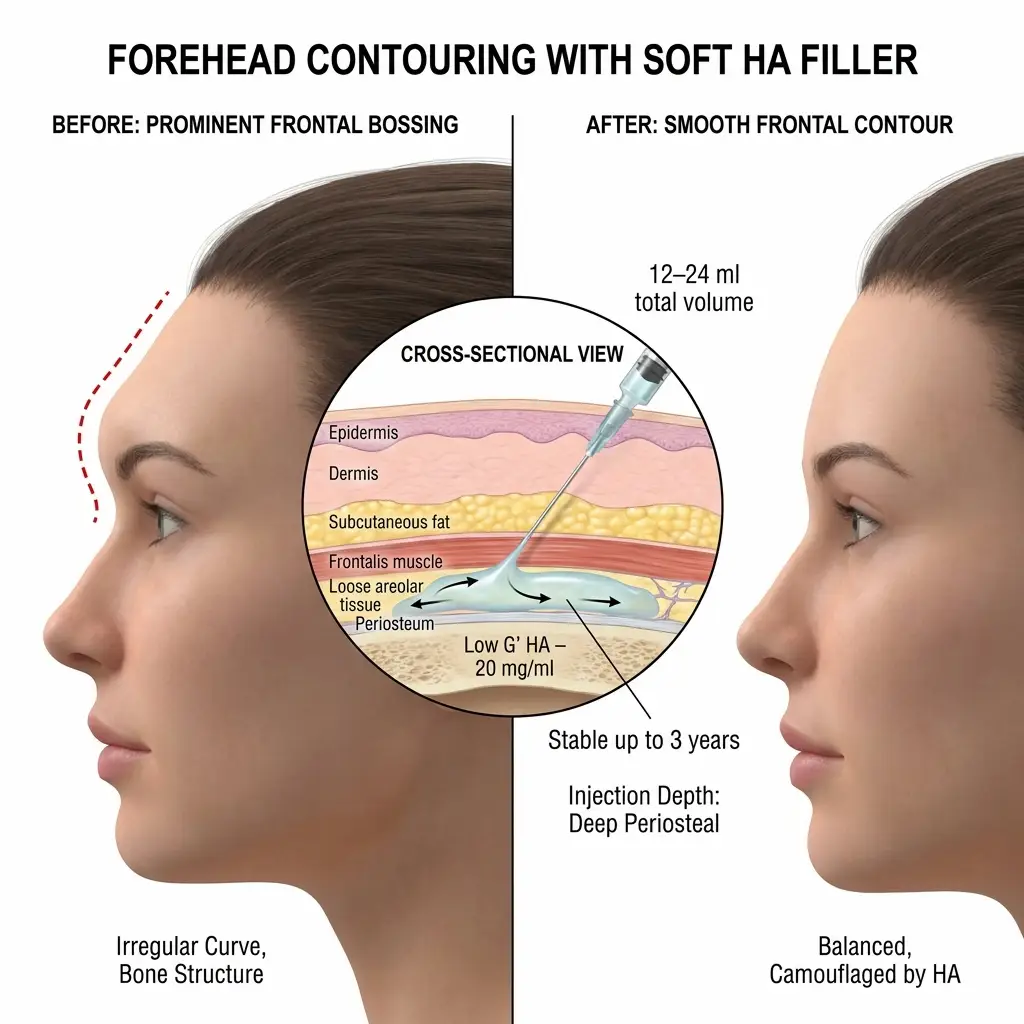
Forehead contouring refers to improving the shape, projection, and smoothness of the forehead. In aesthetic medicine, this may involve softening visible depressions, creating a smoother forehead curve, reducing the visual impact of frontal bossing, or improving the transition between the forehead and upper face.
Frontal bossing is a condition characterized by excessive prominence of the lower frontal bone, particularly near the area above the orbital rim. In severe cases, surgery remains the standard option. However, in selected patients, fillers may be used to camouflage irregularities and create a smoother contour without changing the bone itself.
It is important to understand the difference: filler treatment does not remove bone. Instead, it adds volume strategically to create a more balanced visual contour.
Why Hyaluronic Acid Fillers?
Hyaluronic acid, or HA, is a naturally occurring molecule found in the skin and connective tissues. In aesthetic medicine, HA fillers are used to restore volume, improve facial contours, and support soft tissues.
One of the key advantages of HA fillers is reversibility. If necessary, they can be dissolved using hyaluronidase. This makes them safer and more controllable than non-reversible fillers such as calcium hydroxyapatite or poly-L-lactic acid in certain high-risk or delicate areas.
For forehead contouring, reversibility is especially important because the forehead has thin soft tissue layers and limited space for product placement. Any irregularity, overcorrection, or visible distortion may be more noticeable than in thicker facial regions.
Overview of the Study
The study included 38 patients treated with HA filler for forehead recontouring between January 2021 and January 2024. The group consisted of 36 men and 2 women, with ages ranging from 29 to 72 years and a mean age of 47.6 years.
Patients were followed for 1 to 3 years after treatment. The aim was to evaluate long-term stability, patient satisfaction, safety, and the suitability of a specific type of HA filler for forehead contouring.
All patients requested improvement in forehead appearance, especially a less prominent frontal bossing and a smoother forehead profile. After receiving information about surgical and non-surgical options, they chose the non-surgical approach.
Filler Type and Injection Technique
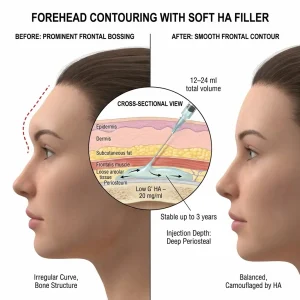
The filler used in the study was a monophasic, cross-linked HA filler with a concentration of 20 mg/ml. It had low cohesivity and low elasticity, with a G’ value of 20 Pa and a G” value of 10 Pa.
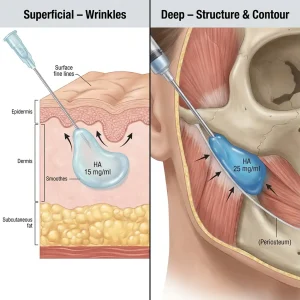
This detail is clinically important. High G’ fillers are usually used for deep structural projection in areas such as the chin or jawline. However, the forehead is different. Its soft tissue layers are thin, and high-elasticity fillers may create visible irregularities even when injected deeply.
For this reason, the authors selected a very soft, moldable HA filler. The goal was not to create a hard projection, but to build a smooth layer of volume over the frontal bone.
Injections were performed perpendicular to the frontal bone, targeting the plane just above the periosteum. The filler was placed behind the frontal fat pads and muscles. Each injection delivered small amounts of product, approximately 0.1 ml at a time, followed by immediate molding.
The marked treatment area was divided into three horizontal zones. The central zone received the highest volume to camouflage frontal bossing, while the upper and lower zones received proportionally smaller amounts to create a natural gradient.
Volume Used
One of the most striking points in this study is the amount of filler required.
The total volume ranged from 12 ml to 24 ml per patient, with an average of 16 ml. This is considerably higher than the volumes commonly used in many facial filler treatments.
The reason is anatomical and technical. A low G’ filler provides softness and moldability but has limited projection capacity. Therefore, more product is needed to build a smooth forehead contour.
This is not a minor detail. Forehead contouring with fillers is not the same as filling a small wrinkle. It is a large-area structural camouflage procedure and requires careful planning, cost consideration, and realistic patient expectations.
Results
All 38 patients completed treatment successfully.
No major complications such as vascular occlusion or infection were reported. Mild redness and minor surface irregularities were observed immediately after the procedure, but they resolved spontaneously.
Eight patients required minor touch-ups at the 21-day follow-up, using an additional 1 to 2 ml of filler.
From the three-month follow-up onward, the aesthetic results remained stable in all cases. No filler resorption, nodules, induration, or filler-related complications were reported.
At the one-year follow-up, patient satisfaction was measured using a Visual Analog Scale. The average score was 91 out of 100, indicating a high level of satisfaction.
In patients followed for up to three years, the results remained stable.
Long-Term Stability
A key finding of this study was the long-term persistence of the forehead contouring effect.
Although HA fillers are generally considered resorbable, deep injections near the periosteum may behave differently from superficial injections. The authors discussed two possible explanations.
First, the periosteal plane may contain less endogenous hyaluronidase, the enzyme that breaks down HA. This may reduce filler degradation.
Second, previous research has suggested that HA injected near bone may induce local tissue changes during the absorption process, potentially contributing to longer-lasting volumization.
These explanations are still not fully proven and require further research. However, the clinical observation in this study was clear: the results remained stable for up to three years in the followed patients.
Why Low G’ Filler May Be Better for the Forehead
The forehead is a difficult area for filler treatment because the tissue is thin and irregularities can be visible.
A firm filler may provide more lift, but it can also create lumps, edges, or unnatural projection. A softer, low G’ filler may be safer for smooth surface integration, especially when the treatment goal is contour blending rather than sharp projection.
In this study, the low G’ filler allowed precise molding and reduced the risk of visible distortion. The trade-off was the need for a larger volume of product.
This is an important clinical lesson: stronger is not always better. In the forehead, a softer filler may produce a more natural and safer result when used correctly.
Comparison with Surgery
Surgery remains the gold standard for significant frontal bossing correction because it directly reshapes the bone. Surgical methods may include bone burring, hydroxyapatite application, or frontal bone osteotomy depending on severity.
However, surgery may carry risks such as hardware palpability, sinus-related complications, scarring, alopecia, anesthesia risks, and recovery time.
HA filler contouring does not replace surgery in severe cases. But for selected patients who want a less invasive, reversible, and lower-downtime option, it may provide meaningful aesthetic improvement.
The key limitation is that filler treatment camouflages the contour rather than removing the underlying bony prominence.
Safety Considerations
Forehead filler treatment must be approached with serious caution. The forehead has important vascular structures, thin tissue layers, and limited tolerance for technical error.
This procedure should only be performed by experienced medical professionals with advanced knowledge of facial anatomy and filler rheology.
Possible risks include bruising, swelling, asymmetry, surface irregularity, infection, vascular occlusion, skin necrosis, and unsatisfactory cosmetic outcome. The fact that no complications were reported in this study does not mean the procedure is risk-free.
Patient selection is also critical. Not every forehead shape can be corrected safely or effectively with fillers.
Limitations of the Study
The study has several limitations.
It was retrospective, meaning the researchers reviewed already-treated cases rather than designing a randomized trial in advance.
The sample size was relatively small, with 38 patients.
There was no imaging-based confirmation of filler persistence, such as ultrasound or MRI.
The study focused on one type of filler and one injection strategy.
Because of these limitations, the findings are promising but should not be interpreted as universal proof that all HA fillers or all injection techniques will produce the same result.
Conclusion
Hyaluronic acid fillers may offer a non-surgical option for forehead contouring in carefully selected patients. In the reviewed study, a soft, low G’ HA filler injected deeply near the periosteum produced stable results for up to three years, with high patient satisfaction and no reported complications.
The main clinical message is that filler selection matters. For the forehead, a soft and moldable filler may be more appropriate than a firm, highly elastic filler, even if larger volumes are required.
Forehead contouring with HA filler should not be marketed as a simple beauty treatment. It is an advanced injectable procedure that requires anatomical precision, realistic planning, and careful patient selection.
When performed correctly, it may provide a reversible, long-lasting, and minimally invasive alternative for selected patients who want smoother forehead contours without surgery.
Reference
Rauso R, Zerbinati N. Long-term Stability and Hyaluronic Acid Filler Selection for Forehead Contouring. The Journal of Craniofacial Surgery. 2025.