Introduction
The hands are one of the most visible areas of the body and often reveal signs of aging earlier than expected. While facial rejuvenation receives most of the attention in aesthetic medicine, the hands can also show age-related changes such as thinning skin, volume loss, visible veins, prominent tendons, dryness, pigmentation, and reduced elasticity.
Because the skin on the back of the hands is thin and frequently exposed to sunlight, environmental stress, detergents, chemicals, and daily mechanical activity, it is highly vulnerable to aging. As a result, hand rejuvenation has become an increasingly important part of a complete aesthetic treatment plan.
A youthful facial appearance may look incomplete if the hands still show advanced signs of aging. For this reason, modern aesthetic protocols often consider hand rejuvenation as part of a broader anti-aging strategy.
Why Do Hands Age?
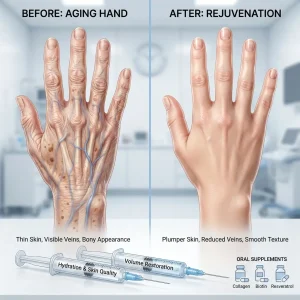
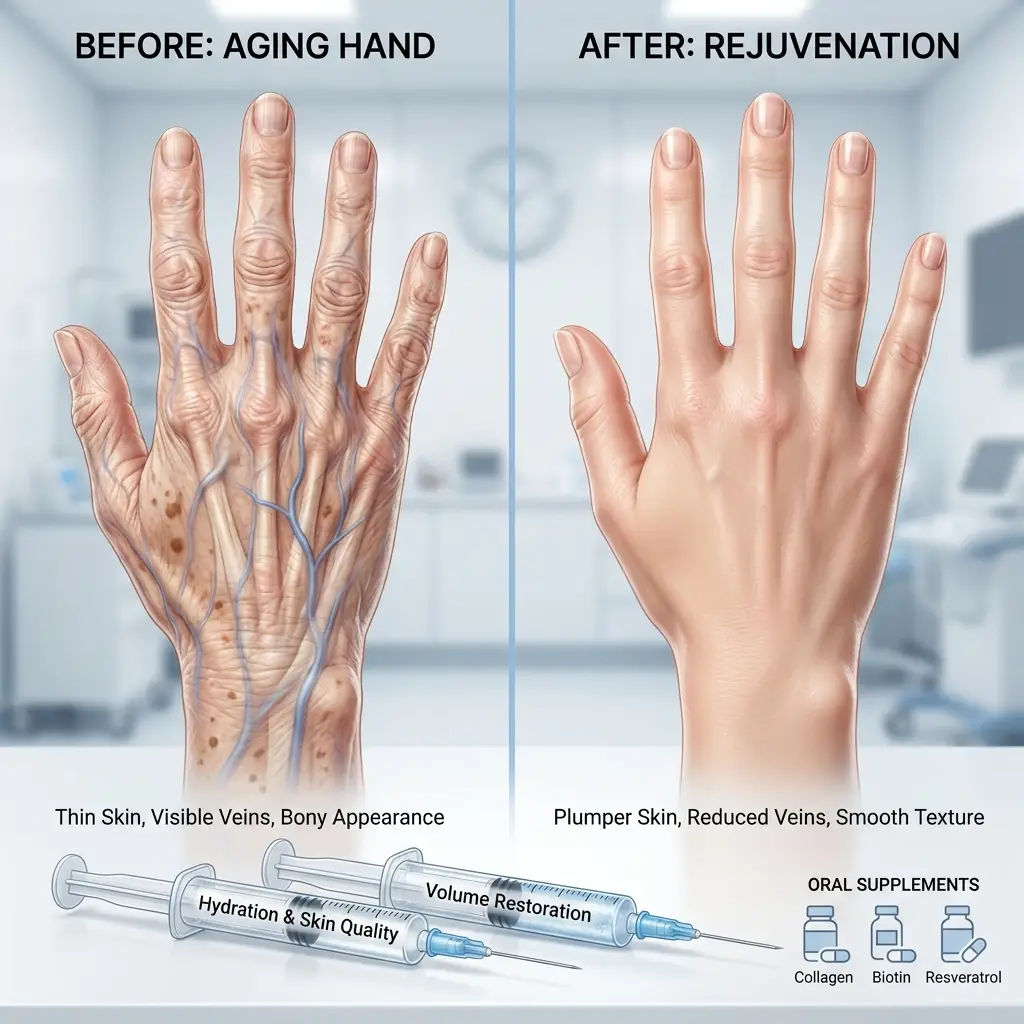
Hand aging is caused by several structural and biological changes. Over time, the becomes thinner and less elastic. Collagen and elastin levels decrease, leading to reduced firmness and skin support. Subcutaneous fat also diminishes, which makes veins, tendons, and bones more visible.
Common signs of hand aging include:
Dry and thin skin
Loss of volume on the back of the hands
Increased visibility of veins and tendons
Uneven skin texture
Reduced elasticity and firmness
Pigmented spots caused by sun exposure
A bony or “gnarled” appearance
These changes are not only cosmetic. They reflect deeper changes in the skin and soft tissue structure, which means that effective hand rejuvenation should address both skin quality and volume loss.
The Role of Hyaluronic Acid in Hand Rejuvenation
Hyaluronic acid, also known as HA, is a biocompatible and biodegradable molecule naturally present in the skin and connective tissues. It has a strong capacity to attract and retain water, which helps improve hydration, elasticity, and skin turgor.
In aesthetic medicine, different forms of hyaluronic acid may be used for different purposes.
Non-cross-linked hyaluronic acid is commonly used for skin bio-revitalization. Its purpose is not mainly to create volume, but to improve hydration, skin texture, elasticity, and overall skin quality.
Cross-linked hyaluronic acid is more structured and is generally used as a dermal filler. In hand rejuvenation, it can help restore lost volume and reduce the visible prominence of veins, tendons, and bones.
When both forms are used together, the treatment can target two major problems at the same time: poor skin quality and loss of volume.
A Combined Protocol for Rejuvenating the Hands
A clinical protocol described by Dr. Giuseppe Di Toro focused on the combined use of hyaluronic acid injections and oral supplementation for hand rejuvenation.
The goal of the protocol was to improve the superficial dry layer of the skin, enhance skin texture, and correct volume loss on the back of the hands.
The injectable treatment included:
Non-cross-linked hyaluronic acid for bio-stimulation and skin hydration
Cross-linked hyaluronic acid for volume restoration
The oral supplement included ingredients such as collagen, hyaluronic acid, resveratrol, copper, zinc, vitamin B6, and biotin. These components were selected to support connective tissue repair, skin renewal, and antioxidant protection.
Treatment Technique
The protocol used a combination of micro-injections and dermal filling.
For bio-revitalization, a series of small superficial injections were performed using a fine needle. This technique was intended to distribute non-cross-linked hyaluronic acid across the skin to improve hydration and texture.
For volume correction, cross-linked hyaluronic acid was injected using a cannula. The purpose was to restore volume in the dorsal hand area and soften the appearance of tendons, veins, and bony structures.
The treatment quantities were adjusted according to patient age and degree of aging. Younger patients generally required less product, while older patients with more visible volume loss and skin thinning required a more intensive protocol.
Age-Based Treatment Planning
The protocol was adapted for different age groups between 40 and 65 years old.
For patients around 40 years old, the treatment focused mainly on bio-revitalization using non-cross-linked hyaluronic acid.
For patients between 40 and 50 years old, non-cross-linked hyaluronic acid was used first, followed by cross-linked hyaluronic acid after approximately two weeks.
For patients between 50 and 60 years old, a larger amount of non-cross-linked hyaluronic acid was used, followed by cross-linked filler for volume correction.
For patients over 60 years old, the protocol included repeated bio-revitalization sessions followed by cross-linked hyaluronic acid to improve volume and tissue support.
Oral collagen-based supplementation was recommended for 30 days in patients up to 50 years old and for 60 days in older patients.
Reported Results
According to the reported clinical experience, the procedure was well tolerated by patients. No delayed complications such as nodules or product thickening were reported.
The results were evaluated through a self-assessment questionnaire. Patients scored several parameters, including:
Volume
Hydration
Brightness
Elasticity
Smoothness
Skin tone
Scores were collected before treatment, one month after treatment, and six months after treatment.
The overall score increased by 82% after one month and remained improved by 64% after six months. These findings suggest that the combined approach may provide both short-term improvement and a degree of sustained benefit over time.
The reported improvements included better hand volume, smoother skin texture, improved skin trophism, increased elasticity, and reduced bony or aged appearance.
Safety Considerations
Although the protocol was described as simple and well tolerated, hand rejuvenation with injectable products remains a medical procedure and should only be performed by qualified professionals.
The hands contain important vascular, nervous, and tendon structures. Incorrect injection technique may increase the risk of complications. Proper anatomical knowledge, sterile technique, appropriate product selection, and careful use of cannulas or needles are essential for patient safety.
Possible side effects may include bruising, swelling, tenderness, temporary irregularities, infection, asymmetry, or vascular complications. Patients should receive a full medical assessment before treatment and should be informed about realistic outcomes and potential risks.
Why a Combined Approach May Be Useful
Hand aging is not caused by a single factor. Therefore, treating only one aspect may produce limited results.
A filler alone may improve volume but may not significantly improve skin quality. Bio-revitalization alone may improve hydration and texture but may not be enough when tendons and veins are highly visible.
Combining non-cross-linked hyaluronic acid, cross-linked hyaluronic acid, and supportive oral supplementation may provide a more complete approach by addressing hydration, volume, elasticity, and tissue quality at the same time.
Conclusion
Hand rejuvenation is an important but sometimes overlooked part of aesthetic medicine. The hands are constantly visible and can reveal age even when the face has been treated.
A combined protocol using non-cross-linked hyaluronic acid for skin quality, cross-linked hyaluronic acid for volume restoration, and oral supplementation for connective tissue support may offer a practical approach to improving the appearance of aging hands.
The key to successful treatment is not simply adding volume. It is choosing the right product, using the correct technique, respecting hand anatomy, and tailoring the protocol to the patient’s age, tissue condition, and aesthetic goals.
When performed properly, hand rejuvenation can improve hydration, texture, elasticity, and volume, helping the hands appear smoother, healthier, and more balanced with the rest of the body.