Introduction
Facial reconstructive surgery can restore form and function after trauma, tumor removal, congenital defects, or major tissue loss. However, even after successful reconstruction, some patients may still experience visible post-surgical irregularities such as contour deformities, volume defects, skin graft depression, tissue stiffness, or asymmetry.
Correcting these secondary deformities often requires additional surgery. However, not every patient is willing or medically suitable to undergo another surgical procedure. In such cases, non-surgical options may play a supportive role in improving facial contour and tissue appearance.
Hyaluronic acid fillers, commonly used in aesthetic medicine for wrinkles and volume restoration, have also been discussed as a possible tool for selected post-surgical facial deformities.
What Are Hyaluronic Acid Fillers?
Hyaluronic acid, also known as HA, is a naturally occurring molecule found in the skin, connective tissue, and joints. In injectable form, HA fillers are used to restore volume, improve contour, soften folds, and support facial tissues.
One of the major advantages of HA fillers is that they are biodegradable and can be dissolved with hyaluronidase if needed. This makes them different from permanent fillers and gives physicians a greater degree of control in case of overcorrection, asymmetry, or unsatisfactory results.
Although HA fillers are mainly known for aesthetic applications, their ability to restore volume may also be useful in certain reconstructive or post-surgical situations.
Why Consider HA Fillers After Surgery?
After reconstructive surgery, some patients may develop contour defects due to scar tissue, tissue loss, graft contraction, or irregular healing. These changes can affect both appearance and tissue mobility.
Traditional correction may involve revision surgery, fat grafting, tissue rearrangement, or flap procedures. These approaches can be effective, but they also involve operating-room time, recovery, donor-site morbidity, cost, and surgical risk.
HA fillers may offer a less invasive option for selected cases. They can be injected into specific areas to improve contour, add volume, and potentially soften fibrotic tissue. This does not mean that fillers can replace reconstructive surgery. Rather, they may be considered as an additional tool in carefully selected patients.
Overview of the Case Report
A case report published in the Journal of Clinical and Cosmetic Dermatology described the use of cross-linked hyaluronic acid filler to improve a post-surgical donor-site deformity following facial reconstruction.
The patient had undergone reconstruction of an oral defect after surgical removal of squamous cell carcinoma of the cheek. A superficial temporal artery perforator flap was used for reconstruction. While this flap can be useful for facial defect repair, the donor site may require a skin graft and may heal with visible contour changes.
In this case, after the surgical areas had fully healed, the remaining donor-site deformity was treated with HA filler injections.
Treatment Approach
The non-surgical correction was started three months after surgery, once healing was complete.
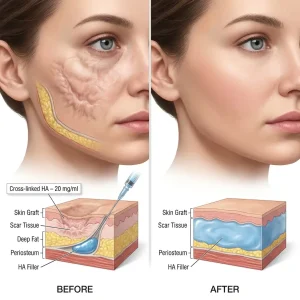
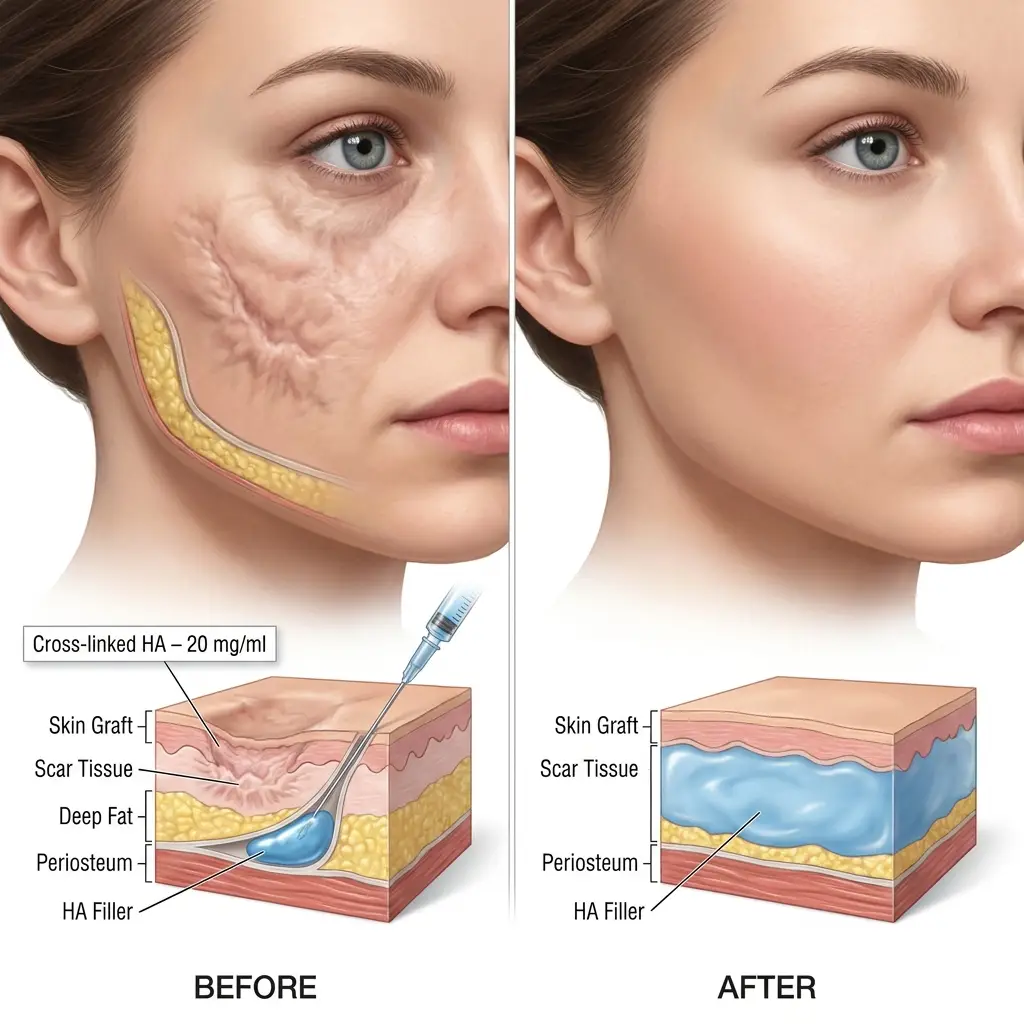
A 20 mg/ml cross-linked hyaluronic acid filler was injected in subperiosteal and supraperiosteal planes. The injections were repeated every three weeks for a total of four sessions.
On average, 0.4 ml of HA filler was used per session.
During the injections, significant resistance was noted. This was likely related to the scar tissue that had formed beneath the skin graft. Despite this resistance, progressive improvement was observed after each treatment session.
Reported Outcome
The treated area showed gradual improvement in volume and contour. The skin graft, which was initially firmly attached and relatively immobile over the frontal bone, became progressively softer and more mobile after treatment.
Nine months after the final injection, the result remained stable in terms of both volume improvement and tissue softness.
The images in the case report show the donor site before and after treatment. The first image demonstrates the healed skin graft with visible contour irregularity. The second image, taken nine months after HA injections, shows improved contour and a softer appearance of the treated area.
Possible Mechanism of Action
The author discussed a possible explanation for the longer-lasting improvement seen after deep HA injections near the bone.
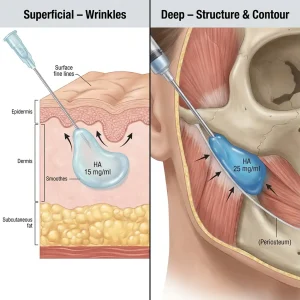
Previous research has suggested that deep injection of cross-linked HA near the periosteum may create local tissue stimulation during the absorption process. This may involve mild inflammatory changes around HA particles and possible activation of periosteal stem cells, contributing to tissue remodeling, fibrosis, capsule formation, or other forms of tissue induction.
This mechanism remains a hypothesis and should not be presented as proven for all patients. More clinical studies are needed to determine which filler types, injection planes, and patient conditions are most appropriate.
Clinical Importance
This case report is important because it expands the discussion around HA fillers beyond routine cosmetic use.
In carefully selected patients, HA fillers may help improve:
Post-surgical contour defects
Localized volume loss
Skin graft irregularity
Tissue stiffness
Facial asymmetry
Depressed or uneven areas after reconstruction
However, this approach requires advanced anatomical knowledge and should only be performed by physicians experienced in both facial anatomy and injectable treatments.
Limitations
This publication is a case report, meaning it describes one clinical situation. It cannot prove that the same approach will work for every patient or every type of post-surgical deformity.
The result depends on many factors, including the type of deformity, scar quality, skin condition, filler rheology, injection plane, timing after surgery, and physician technique.
Not all HA fillers are suitable for reconstructive or post-surgical applications. Different products have different physical properties, including elasticity, cohesiveness, concentration, and lifting capacity. Choosing the wrong product or injecting it in the wrong plane may lead to poor results or complications.
Safety Considerations
HA filler injections in post-surgical areas should be approached with caution. Scarred tissue can have altered anatomy, reduced mobility, changed vascular patterns, and unpredictable resistance during injection.
Possible risks include swelling, bruising, infection, irregularity, overcorrection, vascular compromise, pain, and unsatisfactory cosmetic outcome.
A complete medical history is especially important in patients who have had cancer surgery, radiotherapy, reconstructive procedures, or complex wound healing. Treatment should be coordinated with the patient’s medical and surgical history.
Conclusion
Hyaluronic acid fillers may represent a useful non-surgical option for selected post-surgical facial contour deformities. In the reported case, repeated injections of cross-linked HA filler improved the appearance, volume, and softness of a donor-site deformity after facial reconstruction.
However, this approach should be considered carefully. The evidence is still limited, and more studies are needed before broad conclusions can be made.
The strongest message is that HA fillers are not only cosmetic products. When used by experienced professionals, with proper patient selection and anatomical planning, they may also serve as a supportive tool in selected reconstructive and post-surgical cases.